Advertisement
Advertisement
ATP
[ ey-tee-pee ]
abbreviation for
- adenosine triphosphate: an ester of adenosine and triphosphoric acid, C 10 H 12 N 5 O 4 H 4 P 3 O 9 , formed especially aerobically by the reaction of ADP and an orthophosphate during oxidation, or by the interaction of ADP and phosphocreatine or certain other substrates, and serving as a source of energy for physiological reactions, especially muscle contraction.
ATP
1abbreviation for
- advanced turboprop
- Association of Tennis Professionals
- automatic train protection: a safety system which automatically prevents a train from passing through a stop signal
ATP
2noun
- adenosine triphosphate; a nucleotide found in the mitochondria of all plant and animal cells. It is the major source of energy for cellular reactions, this energy being released during its conversion to ADP. Formula: C 10 H 16 N 5 O 13 P 3
ATP
/ ā′tē′pē′ /
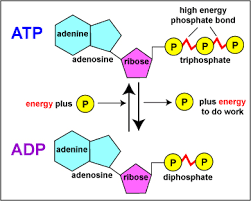
- Short for adenosine triphosphate. An organic compound, C 10 H 16 N 5 O 13 P 3 , that is composed of adenosine and three phosphate groups. It serves as a source of energy for many metabolic processes. ATP releases energy when it is broken down into ADP by hydrolysis during cell metabolism.
ATP
- A key energy -carrying molecule in biological systems. It is produced in the body through the process of cell respiration and in plants through photosynthesis .
Discover More
Word History and Origins
Origin of ATP1
Discover More
Compare Meanings
How does ATP compare to similar and commonly confused words? Explore the most common comparisons:
Discover More
Example Sentences
ATP Player Council members Gilles Simons and Sergiy Stakhovsky were recently both critical of the equal-pay policy.
Despite this, he finished the year 17–0, winning three tournaments and bashing Nadal in the ATP Tour Finals.
The ATP was once a seriously badass union, with a brand of solidarity that would make Marvin Miller proud.
Murray reports that an ATP Tour Manager advised them against taking the court, but seemingly could do no more than that.
The ATP will threaten to nuke the TP, totally unaware that the TP also possesses nukes set to launch on warning.
It was very amusing to see the attention bestowed upon him atp.
Accompanied by the boys John went among the sufferers, and administered the medicine, giving atp.
Boys was only a fellow-student, whose acquaintance Erasmus had made atp 104 Montaigu.
It was named adenosine triphosphate or adenyltriphosphoric acid, usually abbreviated by the symbol ATP.
Advertisement
Discover More
About This Word
What else does ATP mean?
While it can stand for many things, the initialism ATP commonly stands for the Association of Tennis Professionals, the cell-powering chemical adenosine triphosphate, and at this point.
Where does ATP come from?
The Association of Tennis Professionals, or ATP, is the premier, international men’s tennis organization. It was founded in 1972 during the U.S. Open in Forest Hills in Queens, New York. The women’s equivalent is the WTA, or Women’s Tennis Association.
In science, ATP stands for adenosine triphosphate. This chemical, discovered in the 1920s, is important to all life. It stores and releases energy for many cellular processes. It is found in mitochondria.
-
<img loading="lazy" src="https://www.dictionary.com/e/wp-content/uploads/2020/02/ATP.png" alt="" width="251" height="201" />
Community College of Baltimore County
In digital communication, ATP can stand for at this point. This shorthand is often written lowercase as atp. It’s not clear exactly when this acronym came into use, but it spread online in the 2000s.
How is ATP used in real life?
The meaning of ATP depends on context.
If you’re at a tennis match, it’s pretty safe to say that ATP stands for the Association of Tennis Professionals.
This is who I want to Stan on the ATP – Jack Draper ……. pic.twitter.com/T5GwwUtTW2
— Queen Venus Williams (@Venus_Fan4Ever) February 22, 2020
Lock ‘em in 🔒
Which first round clash are you most excited for? 💥@AbiertoTelcel pic.twitter.com/9Z98eefxM5
— ATP Tour (@atptour) February 22, 2020
Everyone from students in biology class to molecular biologists use ATP to refer to adenosine triphosphate. This is one of the most common uses of the acronym ATP.
Free featured article: how is neural activity coupled to cellular metabolic homeostasis? a feedforward mechanism couples activity to enhanced ATP production in axonal mitochondria. Work by Ryan's group https://t.co/0FG7NwXGLl, preview by Graeme Davis https://t.co/0MBvp2uuVx pic.twitter.com/dgBvdxP6Yp
— Neuron (@NeuroCellPress) February 21, 2020
You would not be able to synthesize proteins without ATP. You wouldn’t have ATP without glucose. You wouldn’t have glucose without chloroplasts.
— Chloroplast (@Chlorop44013831) November 13, 2018
Finally, atp for at this point is largely used on social media and in texting. It’s not as widespread, though, as the likes of LOL or OMG.
i look extra bunny today and atp i don't even care 😂🤷🏽♀️
— •feb5th ♒️ (@des2federal) April 3, 2017
More examples of ATP:
“Tennis Australia and the ATP have revealed a new $US15 million ($A20.6 million) team competition which will act as a curtain-raiser to the 2020 season and be hosted in three yet-to-be determined Australian cities.”
Sydney Morning Herald, November 2018
Advertisement
Advertisement
Advertisement
Browse