Advertisement
Advertisement
predicate
[ noun adjective pred-i-kit; verb pred-i-keyt ]
noun
- Grammar. (in many languages, such as English) one of the two main parts of a sentence, containing the verb and any of its objects, modifiers, or other completions, and generally expressing an action, state, or condition: for example, got here quickly in Larry got here quickly, or ate a cookie in I ate a cookie, or slept in The exhausted student slept. Compare subject ( def 9 ).
- Logic. that which is affirmed or denied concerning the subject of a proposition.
verb (used with object)
- to found or derive (a statement, action, etc.); base (usually followed by on ): The modern situation is predicated on the illusion of total independence.
He predicated his behavior on his faith in humanity.
The modern situation is predicated on the illusion of total independence.
A spokesperson predicated that the Supreme Court wouldn't overrule the doctrine of dual sovereignty.
- Logic.
- to affirm or assert (something) of the subject of a proposition.
- to make (a term) the predicate of such a proposition.
- to connote; imply:
His retraction predicates a change of attitude.
verb (used without object)
- to make an affirmation or assertion.
adjective
- predicated.
- Grammar. belonging to the predicate:
a predicate noun.
predicate
verb
- also intr; when tr, may take a clause as object to proclaim, declare, or affirm
- to imply or connote
- foll byon or upon to base or found (a proposition, argument, etc)
- logic
- to assert or affirm (a property, characteristic, or condition) of the subject of a proposition
- to make (a term, expression, etc) the predicate of a proposition
noun
- grammar
- the part of a sentence in which something is asserted or denied of the subject of a sentence; one of the two major components of a sentence, the other being the subject
- ( as modifier )
a predicate adjective
- logic
- an expression that is derived from a sentence by the deletion of a name
- a property, characteristic, or attribute that may be affirmed or denied of something. The categorial statement all men are mortal relates two predicates, is a man and is mortal
- the term of a categorial proposition that is affirmed or denied of its subject. In this example all men is the subject, and mortal is the predicate
- a function from individuals to truth values, the truth set of the function being the extension of the predicate
adjective
- of or relating to something that has been predicated
Discover More
Derived Forms
- ˌprediˈcation, noun
Discover More
Other Words From
- pred·i·ca·tion [pred-i-, key, -sh, uh, n], noun
- pred·i·ca·tive [pred, -i-key-tiv, -k, uh, -, pri-, dik, -, uh, -tiv], adjective
- pred·i·ca·tive·ly adverb
- non·pred·i·ca·tive adjective
- non·pred·i·ca·tive·ly adverb
- sub·pred·i·cate noun
- sub·pred·i·ca·tive adjective
- un·pred·i·cat·ed adjective
- un·pred·i·ca·tive adjective
- un·pred·i·ca·tive·ly adverb
Discover More
Word History and Origins
Origin of predicate1
Discover More
Word History and Origins
Origin of predicate1
Discover More
Example Sentences
Some of that will be predicated on how well its international business does give that it accounted for 15% of its second-quarter revenues despite making up almost 75% of the user base.
Globalization—the ideal of an interconnected world—is predicated on the idea that we are stronger working together than split apart.
However, the busybody’s actions and activities are predicated not on what is visible but by what they imagine they are seeing, and this is where it gets dicey.
The rules governing the trust layer display are predicated on a very shallow “job category” to “job type” to a keyword-based ontology.
Overnight, multinational law firms closed their offices, and businesses predicated on collaboration and “face time” moved their faces to video-conferencing software.
FRIEDMAN: I think you also laid the predicate for the Iran negotiations.
His 2004 Democratic Convention address propelled him into the national spotlight, laying the presidential predicate.
The major term is usually the predicate of the major premise and the predicate of the conclusion.
An argument that uses as a premise such a cause may predicate its effect as a conclusion with absolute certainty.
Forcing the subject toward the position usually occupied by the predicate emphasizes the subject.
Unity therefore dwells within us, and it is in us without the object of which we predicate that it is some one thing.
To predicate it of activity, would be to make it depend on things alien to virtue and the soul.
Advertisement
Discover More
More About Predicate
What does predicate mean?
The predicate is the part of the sentence or clause that says what the subject is or isn’t doing.
In the sentence I ran, the subject is I. The subject is the person, place, or thing that is performing an action. The predicate in this sentence is ran and is the action that the subject is performing.
A predicate always contains a verb, which may actually be a verb phrase. In the sentence I ran away from the angry dog, the entire predicate is ran away from the angry dog. In this case, the verb ran is being modified by a prepositional phrase that says what the subject of the sentence (I) was running from.
You can also have a compound predicate, in which one subject is performing more than one action at the same time. In the sentence, My sister studies French and works at a fancy restaurant, the subject (my sister) is performing two actions (studies French and works at a fancy restaurant). In this sentence, the two predicates are joined by the conjunction and.
Some sentences can be very long and complex, as in After explaining the differences between Batman and Man-Bat, my friend spoke for hours about the long and intricate history of batty superheroes. But just remember that the predicate is everything that says what a subject is doing.
Clauses contain at least one subject and predicate but isn’t necessarily a complete sentence. For example, in I told him about the girl that I once knew, that I once knew is a clause. The clause contains the subject I and the predicate once knew.
Why is predicate important?
The first records of the term predicate come from around 1400. It ultimately comes from the Latin praedicāre, meaning “to declare publicly” or “to assert.” In grammar, the predicate declares or asserts what that the subject is (or isn’t) doing.
While a predicate often says what a subject is doing, it can also say what it isn’t doing when the verb is modified by a negative word such as not or never, as in Bill is not going to the party.
Did you know … ?
The shortest possible sentence in English contains just a predicate: Go! In this case, the subject (“you”) is not written but is understood.
What are real-life examples of predicate?
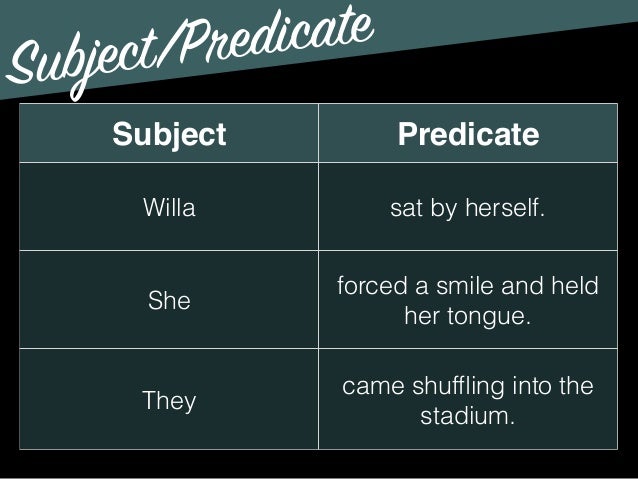
This image shows an example of sentences split into a subject and a predicate.
Slideshare.net / Sam Georgi
Predicates are taught early on in grammar education.
Ugh, trying to remember 6th grade grammar. Learning about predicates
— Teaching the Civil War (@fifer1863) September 14, 2008
Subject and predicate agreements are sexy.
— Preston “Get Vaccinated” Mitchum, he/him (@PrestonMitchum) April 8, 2014
Quiz yourself!
A predicate always contains a:
A. noun
B. verb
C. adjective
D. adverb
Advertisement
Advertisement
Advertisement
Browse